


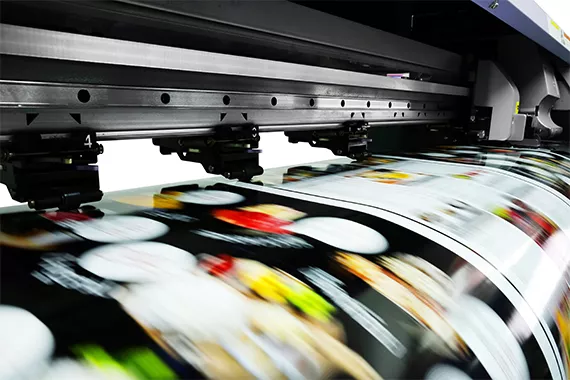
Everything you need to know about digital printing and finishing
From printing to finishing
Since 1969, when digital printing was introduced by the company Xerox, specialized in printers and copiers, a lot has happened. Digital printing has become widespread today thanks to the constant and rapid evolution of technology and inks, offering employment opportunities in various sectors such as publishing, commercial, industrial, packaging, and interior decoration. All of this has allowed digital printing to become highly competitive compared to offset printing and to be used in both small and large formats.
What is digital printing?
Digital printing is based on the ability to directly print a digital-format image on a support without using plates or matrices, as is the case with offset printing. Specifically, digital printing uses technologies that allow sending a file to the digital printer. Files are generated by a PC or other electronic devices such as smartphones and are in PDF, JPG, TIF, etc. formats. Ink is directly printed on the support to be printed.
Thanks to the digitization of printing, it can be confidently stated that there are no more limits to creativity today. This technology allows printing images, graphics, photos, texts on a wide variety of supports quickly, at low costs, while maintaining high quality. It is particularly suitable for small print runs, as it saves the costs of plates used in offset printing, making it economically competitive.
Large-format digital printing uses UV, UV gel, latex, solvent, eco-solvent, and sublimation printing; laser or inkjet printers, on the other hand, are intended for domestic use.
where is large-format digital printing used?
The efficiency and quality of the technologies used in digital printing allow printing on various supports and in various applications, especially for large-format printers.
Regarding supports, digital printing has opened up new horizons. In addition to printing on traditional paper and cardboard, many others have been added. These include flexible media such as wallpaper, canvas, vinyl, reflective material for road signs, fabrics, and rigid substrates such as forex, aluminum (dibond), corrugated cardboard, plexiglass, wood, ceramic, cardboard, sandwich, and many others.
An infinite number of materials find applications in different sectors. Let's see the main ones in detail:
- Visual communication to produce advertising signs, posters, banners, posters, banners, backlit graphics, gadgets, banners/roll-ups, graphics for fairs, events, and points of sale also made with fabrics (soft signage), vehicle decoration.
- Interior decoration for covering wall surfaces in residential, retail, work, and hospitality areas with wallpaper; sublimated fabric for interior furnishings such as curtains.
- Fashion and sports clothing with sublimated fabrics.
- Packaging in cardboard, corrugated cardboard.
- Road signage for printing reflective material for road signs.
Advantages of digital printing
Digital printing has evolved and spread rapidly in recent years because it offers numerous advantages over offset printing. Here are the main advantages:
- Low costs: digital printing has very rapid start times, no start-up costs, and does not require plates or matrices.
- No need for a minimum print run: it is possible to print even a few copies, with an economic saving in warehouse stocks.
- High level of customization: it is possible to print even a single copy, slightly affecting the final price.
- Printing file modifications possible until the last minute.
- Faster workflow with quicker delivery times.
- High print quality and color rendering control thanks to the continuous evolution of technologies and inks.
- Variety of flexible and rigid supports to print on.
Large-format digital printing and finishing
Post-printing, which includes finishing the printed product, is a fundamental phase in the digital printing process, as it makes the printed material a finished product. It can be said that finishing is as crucial as the preceding printing phase.
Demands for low print runs, customization, fast delivery times (fast time to market) drive printers to seek post-printing solutions that optimize time and quality. This has led to a continuous demand for automation in the digital printing workflow and a constant search for technical innovations by post-printing/finishing equipment manufacturers.
The digital printing process can be summarized as follows:
Subject to be printed in a file > Technology that includes the printer and ink > Flexible or rigid support to be printed on > Finishing of the product in the post-printing phase
Finishing processes of the printed product make it usable and saleable. For example, an outdoor advertising poster will have a short life if it is not "finished" with a lamination film that protects it from the weather. Other post-printing processes enhance the printed support, as in packaging, for example. The most common finishing processes in large-format digital printing are lamination, cutting, welding, eyeleting, sublimation.
It should be noted that most finishing in large-format digital printing is done by offline equipment; this remains the most used option when using different supports and having small quantities. In recent years, however, there has been an increase in the demand for workflow automation, as it increases productivity. Particularly widespread is the combination of printing with in-line cutting, which speeds up production and saves time. Printing and cutting functions can be entrusted to a single operator, eliminating the time spent moving the support from the printer to the cutter.
Flexa, with its wide range of high-quality equipment for finishing of large format digital prints, offers solutions for every business need, for exceptional results that highlight your commitment to excellence.
