


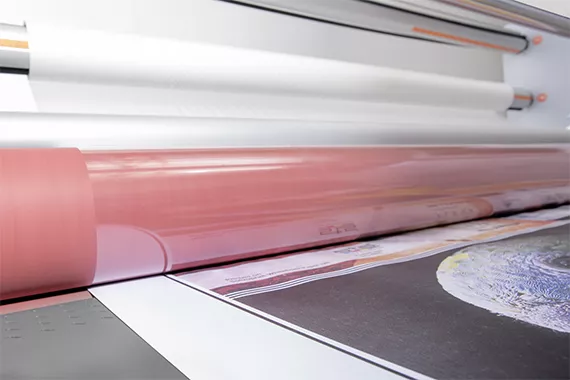
The lamination process in large-format digital printing
How to choose a laminator
The lamination process in large-format digital printing can truly add value to the printed product and is used in numerous industry applications. The post-printing phase, or product finishing, is indeed as crucial as the preceding one, and lamination is an integral part of this process.
Laminating involves applying a lamination film to flexible printed supports (such as vinyl or paper), or to rigid supports (such as corrugated cardboard, panels, etc), using a laminator.
The most popular large-format laminators are those with a working width of 1600 mm, such as the Flexa Easy Lite model, as they seamlessly integrate with common digital printers and plotters of the same format.
In digital printing, there are primarily two types of lamination processes, each with specific characteristics to adapt to various needs and applications.
1. Hot lamination: This type involves the use of thermoplastic films that are melted onto the print through heat and pressure. Thermoplastic films can be glossy or matte and provide effective protection against wear and environmental damage.
2. Cold lamination: In this case, pressure-sensitive adhesive films are used, which do not require heat for adhesion. Cold lamination is ideal for heat-sensitive materials or to achieve matte or satin finishes.
Why use a laminating machine for your prints!
With a laminator, various types of processing can be carried out. Below are listed numerous potentials of this machine, which is a valuable ally for finishing large-format digital prints and is essential in any printing house!
With a laminator, you can:
- Protect images from scratches and wear to extend the life of the printed support. Ideal for both indoor and outdoor use; in the latter case, the print is also protected from weather conditions and ultraviolet rays, preventing color fading.
- Enhance the printed support through the lamination film; there are many available in the market with different finishes and effects (glossy, matte, semi-matte, anti-UV, etc.)
- Laminate images on rigid and semi-rigid supports such as forex panels, dibond, kapamount, plexiglass, and cardboard.
- Apply double-sided adhesives, colored films, reflective and anti-UV films for pre-spaced stickers, company signage, construction site signs, and vertical road signs.
- Encapsulate, or laminate the flexible support on both sides, creating a kind of "sealing" of a printed image.
How to choose the laminator?
There are different types of laminators in the market, and the choice must be made by analyzing the processing needs of each individual company.
The most important parameters to consider when evaluating the purchase are:
- Cold film processing (with suitable liner up to 60°C) or hot film processing (starting from 80°C)
- Type of lamination process to be carried out: roll-to-roll lamination (from printed roll to laminated roll), single sheets, application tape, panels (the most common being forex)
- Production volumes
- Dimensions of the material to be laminated and printer dimensions
- Cost of the machine/investment
Once these questions are answered, it is possible to identify the model that best suits one's needs.
Hot or cold lamination?
The choice between a hot laminator (up to 120°C) or a cold laminator with a heated upper roller (up to 60°C) depends on the type of applications and the starting support.
The cold laminator with a heated upper roller works with self-adhesive films coupled with silicone-coated/liner paper that can be heated up to a maximum of 50°/60°C.
This type of laminator is suitable for applying lamination film for the following applications: PVC vinyl, pre-spaced adhesive with application tape, floor graphics, fair and event graphics, indoor and outdoor displays, car wrapping, using the specific cast film applied at a maximum temperature of 30°C, membrane keyboards, road signs, signs, and construction or company signs.
Some cold laminators with a heated upper roller are also used outside of large-format digital printing. These are "special" laminators suitable for industrial applications. In the furniture sector, for example, they can be used to apply a protective film to kitchen cabinet doors. Another sector is the glass industry, where a pressure-sensitive film is applied to the substrates: for example the application of anti-fog film on the inner surface of supermarket freezer glass doors to prevent them from fogging up when opened.
The hot laminator applies the lamination film with an adhesive that "activates" from 80°C upwards, up to 140°C. The hot film is cheaper than the cold film, as it does not have the liner or silicone paper. The hot laminator is used in the packaging sector, especially in luxury packaging, cardboard and packaging, laminating corrugated cardboard or cardboard. The hot lamination is also used to encapsulate paper: the hot lamination film is applied simultaneously to the front and back of the sheet, creating a "sealed" end product, durable over time and very pleasant to the touch. In this case, the laminator will be equipped with a double hot roller.
There are also models of hot laminators suitable for coupling technical films to flexible materials used in the industrial field (automotive, fashion, pharmaceuticals, electronics, and more). Coupling in this case requires high temperatures.
What are the important parameters for choosing a laminator?
The quality of the laminated support depends greatly on the technical characteristics of the laminator. Therefore, it is important to define and choose the appropriate laminator by evaluating the most important parameters based on your business needs:
- Roller diameter: a larger roller means higher speed and therefore higher productivity; the lamination film remains more in contact on the roller, achieving a better lamination result.
- Pressure: affects the final quality of print lamination. Excessive pressure produces the "smile effect" that ruins lamination and damages laminator components.
- There are two types of pressure:
- Pneumatic pressure: often preset for easy and fast processing. Compressed air is required and is usually suitable for less experienced operators.
- Mechanical pressure: allows very precise adjustment. Compressed air is not required and is ideal for experienced operators.
- Temperature: is crucial, both in hot lamination (cardboard, encapsulation), and in cold lamination because it eliminates the "Silvering" effect.
- Speed: increases the productivity of cold lamination up to 60°C. In the market, there are laminators that can work up to 20 meters per minute in "roll-to-roll" mode.
Flexa, with its wide range of high-quality laminators, offers tailor-made solutions for every business need, for exceptional results that highlight your commitment to excellence.
